
If you have been pulled over on suspicion of driving while intoxicated in Texas, there is a strong chance the officer asked you to perform field sobriety tests. These roadside evaluations are among the most common tools law enforcement uses to build probable cause for a DWI arrest, yet many drivers do not fully understand what these tests involve or how subjective they can be. According to the National Highway Traffic Safety Administration (NHTSA), impaired driving claimed over 13,500 lives in 2022 alone, and officers across Texas rely heavily on field sobriety testing during traffic stops to identify potentially impaired drivers. However, the science behind these tests is far from perfect, and a failed test does not guarantee a conviction. Understanding how these evaluations work and where they fall short is one of the most important steps you can take to protect your rights after a DWI stop in the Dallas–Fort Worth area.
What Are Field Sobriety Tests?
Field sobriety tests are a series of physical and cognitive exercises that police officers administer during traffic stops when they suspect a driver may be intoxicated. The NHTSA developed and endorsed three specific tests, collectively known as the Standardized Field Sobriety Test (SFST) battery. These are the only tests for which the agency has identified validated clues of impairment, and they have been used by law enforcement nationwide since the early 1980s.
The Horizontal Gaze Nystagmus (HGN) Test
During the HGN test, the officer holds a small object, such as a pen or flashlight, in front of your eyes and asks you to follow it with your gaze while keeping your head still. The officer is looking for involuntary jerking of the eye, known as nystagmus, which tends to become more pronounced when a person has consumed alcohol. The officer checks for three specific clues in each eye, for a total of six possible clues.
The Walk-and-Turn Test
This divided-attention test requires you to take nine heel-to-toe steps along a straight line, turn in a specific manner, and take nine steps back. The officer watches for eight possible clues of impairment, including starting before the instructions are finished, stepping off the line, using your arms for balance, or taking the wrong number of steps. The test is designed to challenge your ability to follow directions while performing a physical task simultaneously.
The One-Leg Stand Test
The one-leg stand requires you to raise one foot approximately six inches off the ground and count aloud for 30 seconds. Officers look for four clues during this test: swaying, using arms for balance, hopping, or putting your foot down. Like the walk-and-turn, this test evaluates your ability to divide your attention between a balancing task and a counting task.
How Reliable Are Field Sobriety Tests?
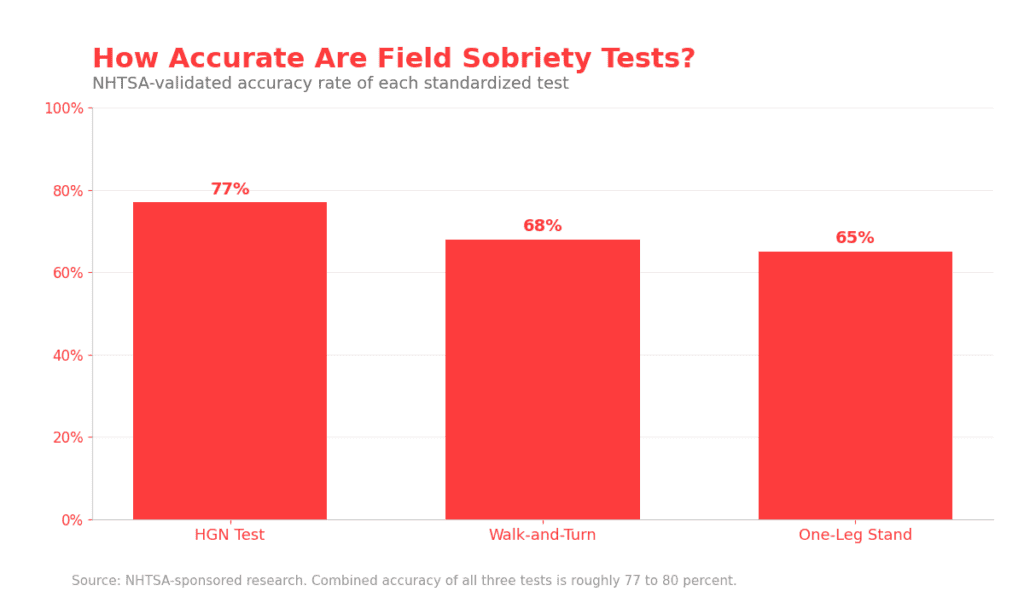
While law enforcement agencies often present field sobriety tests as reliable indicators of impairment, the actual accuracy rates tell a more nuanced story. Research sponsored by the NHTSA found that the HGN test has an accuracy rate of approximately 77 percent, the walk-and-turn test is accurate about 68 percent of the time, and the one-leg stand test comes in at roughly 65 percent accuracy. Even when all three tests are combined, studies suggest the overall accuracy rate sits around 77 to 80 percent for detecting blood alcohol concentrations at or above 0.08 percent.
What these numbers mean in practical terms is significant. Even under the best conditions, these tests produce false positives in a meaningful percentage of cases. In other words, completely sober individuals can and do fail these tests. The accuracy rates reported by the NHTSA were achieved under controlled research conditions with trained officers, and real-world roadside conditions are rarely that ideal.
Common Mistakes That Affect Field Sobriety Test Results
Numerous factors beyond alcohol consumption can cause a person to perform poorly on field sobriety tests. Understanding these variables is critical, because many DWI arrests in the Dallas–Fort Worth area stem from test results that were influenced by something other than intoxication.
Officer Administration Errors
The NHTSA has emphasized that the validity of these tests depends entirely on standardized administration. If the officer gives unclear instructions, demonstrates the test incorrectly, or fails to ask about medical conditions beforehand, the results can be compromised. Even minor deviations from the prescribed procedure can undermine the evidentiary value of the tests.
Environmental and Physical Factors
Roadside conditions are rarely ideal for physical performance tests. Uneven pavement, poor lighting, heavy traffic creating distractions, and inclement weather can all affect a person’s balance and coordination. Additionally, physical conditions such as injuries, obesity, inner ear disorders, age, and even the type of footwear a person is wearing can cause poor performance that has nothing to do with alcohol consumption. Nervousness and anxiety during a police encounter can also impair a person’s ability to follow instructions and maintain composure.
Medical Conditions That Mimic Impairment
Certain medical conditions can produce symptoms that officers may mistake for signs of intoxication. Neurological conditions, eye disorders, diabetes, fatigue, and even certain medications can cause nystagmus, poor balance, or difficulty with coordination. Without proper medical training, officers may not be equipped to distinguish between impairment and a legitimate medical issue.
How to Challenge Field Sobriety Test Evidence in Your DWI Case
Just because you were arrested based on field sobriety test results does not mean the evidence against you is airtight. An experienced DWI defense attorney can challenge this evidence on multiple fronts, and doing so can be the difference between a conviction and a dismissal or reduction of charges.
Questioning the Officer’s Training and Procedure
A defense attorney can examine whether the officer who administered your tests was properly trained and certified in SFST procedures and whether the tests were conducted in strict compliance with NHTSA guidelines. Any deviation from the standardized protocol can weaken the prosecution’s case, because the NHTSA itself has acknowledged that the tests’ validity depends on proper administration.
Presenting Alternative Explanations
Your attorney can introduce evidence of medical conditions, physical limitations, environmental factors, or emotional stress that may have contributed to your test performance. Expert witnesses may also be called to testify about the known limitations of field sobriety testing and the high rate of false positives.
Reviewing Dashcam and Body Camera Footage
Video evidence from the officer’s dashcam or body camera can be invaluable in a DWI defense. The footage may reveal that the officer gave confusing instructions, that road conditions were poor, or that you actually performed the tests better than the officer’s report suggests. In many cases, the video tells a very different story than the arrest report.
Protect Your Rights with a Dallas–Fort Worth DWI Defense Attorney
Field sobriety tests are just one piece of the puzzle in a Texas DWI case, and they are far more fallible than most people realize. A failed test does not have to define the outcome of your case. With the right legal strategy, the evidence against you can often be challenged, weakened, or even excluded entirely.
If you are facing DWI charges in the Dallas–Fort Worth area and field sobriety test results played a role in your arrest, Buck Johnson Law is here to help. Our team understands the science and the law behind these tests, and we are prepared to fight aggressively on your behalf. Contact Buck Johnson Law today to schedule a consultation and take the first step toward protecting your future.