
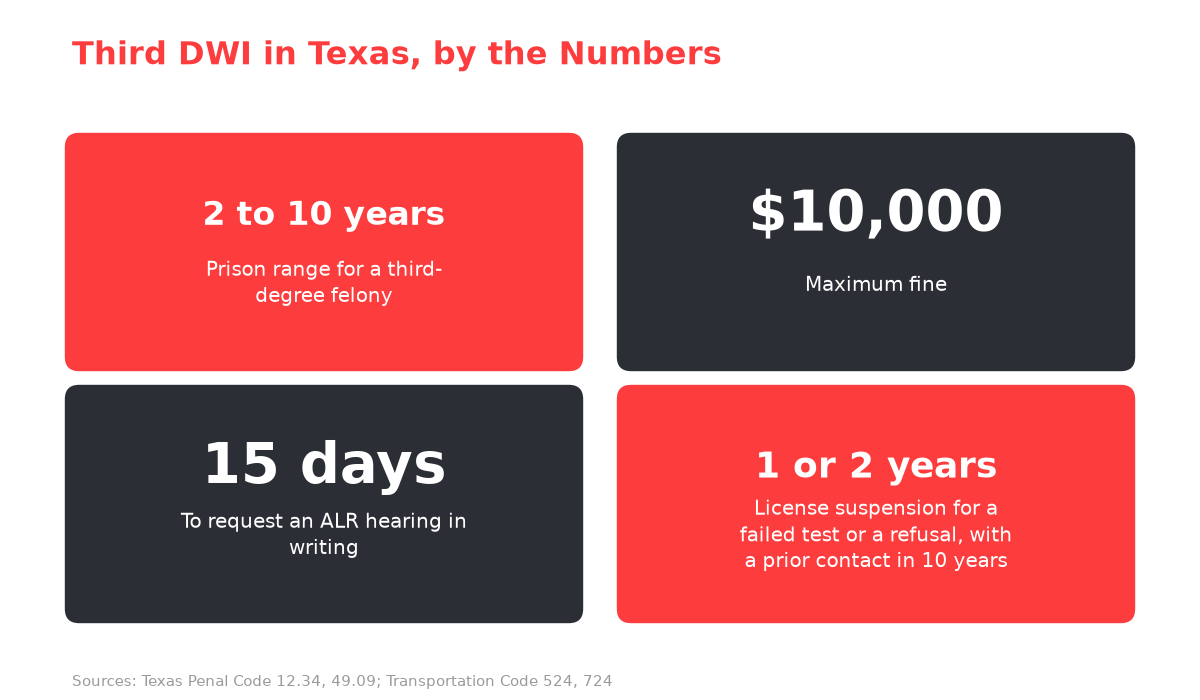
A third DWI in Texas is a third-degree felony under Texas Penal Code 49.09(b), punishable by 2 to 10 years in prison and a fine of up to $10,000. The State must prove two prior DWI-type convictions at trial, and there is no time limit on how old those convictions can be. If you or someone you care about is facing a third DWI in Texas, the rules are different from a first or second offense, and the decisions made in the first two weeks matter.
Why Is a Third DWI in Texas Charged as a Felony?
Texas Penal Code 49.09(b) is the enhancement statute. Under that provision, a standard DWI charge under Section 49.04 becomes a third-degree felony when the State can show, at trial, that the defendant has been convicted two times of an intoxication-related offense such as DWI, flying while intoxicated, boating while intoxicated, or operating an amusement ride while intoxicated. A single prior intoxication manslaughter conviction is enough on its own to trigger the felony enhancement.
Which Prior Convictions Count
The following types of prior convictions can be used to elevate a new DWI to felony status:
- Prior DWI convictions (first or second offense)
- Boating while intoxicated
- Flying while intoxicated
- Operating an amusement ride while intoxicated
- One prior intoxication manslaughter conviction under Penal Code 49.08
The State must prove each prior conviction at trial. That means producing records showing the conviction was valid, final, and tied to you. If the documentation is incomplete or the conviction cannot be authenticated, the enhancement can fail.
Why Old Convictions Still Count
Texas eliminated the time limit on prior DWI convictions for felony enhancement purposes in 2005. Before that change, only convictions within a certain window could be used. That window no longer exists, so a DWI conviction from 1998 or 2003 counts the same as one from last year. That is why a review of your full record comes first in a third offense case. Our overview of DWI charges in Texas explains how each level of charge works.
What Penalties Can a Third DWI Carry?
The punishment range for a third-degree felony in Texas is set by Texas Penal Code 12.34: 2 to 10 years in the Texas Department of Criminal Justice and a fine of up to $10,000. Those are the limits the law sets. Where a case lands, and what options are available, depends on the facts and the record, which is why the defense work starts early.
Prison and Fines
Two years is the minimum prison term and ten years is the maximum. Criminal history, the facts of the arrest, and whether anyone was hurt can all affect where a sentence falls. The $10,000 fine is a cap, not a set amount. The cost of a felony DWI also reaches past the sentence itself, into legal fees, lost income, and future work.
Your Driver’s License and the 15-Day ALR Deadline
The criminal case and your driver’s license are two separate proceedings, and the license side moves faster. Under Transportation Code 524.031, you have 15 days from the date you receive notice of suspension to request an Administrative License Revocation hearing in writing. If you had a prior alcohol-related or drug-related enforcement contact in the preceding 10 years, a failed breath or blood test carries a one-year suspension under Section 524.022(a). A refusal to provide a specimen carries a two-year suspension under Section 724.035 if there is a prior enforcement contact in that same window. Missing the 15-day deadline means automatic suspension with no hearing.
What Happens After a Third DWI Arrest?
The hours and days after a third DWI arrest move quickly and every decision has consequences. Knowing what to expect puts you in a better position to act on the things that are still within your control.
Blood Draws with Two Prior Convictions
Texas Transportation Code 724.012(b) requires officers to collect a specimen even without consent when the driver has two or more prior DWI convictions. This is a mandatory draw situation. Officers still need a warrant or, in its absence, probable cause plus exigent circumstances under Section 724.012(e). The warrant requirement does not disappear simply because the draw is mandatory. How the blood was obtained, whether the warrant was properly issued, and whether the sample was handled correctly in the lab are all areas a defense attorney examines when building a challenge to the blood evidence.
Bail and the First Hearing
After arrest, a magistrate sets bail under Code of Criminal Procedure Article 17.15. The amount is not fixed by a schedule. The magistrate weighs your ability to pay, your criminal history, any prior failures to appear, and the safety of the community, so prior convictions are part of what the magistrate considers. For a plain-language breakdown of DWI bail vs. bond in Texas, see the firm’s dedicated post.
How a Former Prosecutor Looks for Weak Points in a Felony DWI
Buck Johnson spent years as a prosecutor with the Dallas County District Attorney’s office, where he prosecuted hundreds of DWI cases. He knows how the State builds a felony DWI, because he built them. That experience shapes how he looks at a third DWI case: not from the outside, but from inside the playbook the State is running.
Proving the Prior Convictions
The enhancement is the State’s burden. Prosecutors must produce certified court records showing each prior conviction was valid, final, and entered against the right person. Issues the defense checks include:
- Records from other jurisdictions that are incomplete or improperly certified
- Name discrepancies between the defendant and the conviction record
- Convictions that were set aside, vacated, or otherwise legally defective
- Plea documents that do not reflect a knowing and voluntary waiver
If the State cannot prove both prior convictions, the felony enhancement cannot stand as charged.
Challenging the New Arrest
The prior convictions are only half of the case. The State still has to prove the new DWI. That means the traffic stop must have been lawful, the field sobriety tests must have been administered correctly, and the breath or blood evidence must have been collected and analyzed according to protocol. Buck is trained and qualified as a practitioner of the standardized field sobriety tests that officers use, which means he can identify errors in how the tests were conducted, not just argue that they seem unfair. Every link in the evidentiary chain is a place where the defense looks for gaps.
Contact Buck Johnson Law for Third DWI Defense in Dallas
A third DWI in Texas is a felony charge, and the 15-day ALR deadline means the clock is already running. Buck Johnson Law is based in Dallas and serves clients across Dallas-Fort Worth and North Texas. As a former Dallas County prosecutor, Buck understands how the State builds these cases and where they can be examined. If you are ready to talk about what comes next, contact our Dallas DWI lawyer to discuss your situation.