
Your license is not suspended the moment you are arrested for DWI in Texas. The officer takes your physical license and hands you a Notice of Suspension that serves as a temporary driving permit for 40 days. After that, your license suspends automatically unless you request an ALR hearing in Texas in writing within 15 days of receiving the notice, as required by Texas Transportation Code Sections 524.031 and 724.041. Missing that 15-day window waives your right to contest the suspension before it takes effect. Understanding exactly how this process works, and moving fast, is the difference between keeping your driving privileges and losing them for months.
What Is an ALR Hearing in Texas?
An ALR hearing in Texas is a civil administrative proceeding that is completely separate from your criminal DWI case. It deals only with your driving privileges, not your guilt or innocence on the criminal charge. The two cases run on parallel tracks, and the outcome of one does not automatically determine the outcome of the other.
A few key facts about how the process is structured:
- The presiding judge: A state administrative law judge employed by the (SOAH) handles the case, not a criminal court judge.
- What DPS must prove: The Texas Department of Public Safety carries the burden of proof and must establish two things: that you were lawfully stopped and arrested, and that you either failed or refused a breath or blood test.
- Your opportunity to challenge: The hearing gives you the right to contest the lawfulness of the traffic stop, the basis for arrest, whether the test was administered according to required protocols, and whether the testing instrument was properly maintained and certified.
Because DPS bears the burden, gaps in their evidence matter. An attorney who understands what that evidence looks like, and where it breaks down, can press those gaps effectively.
Is Your License Suspended Immediately After a DWI Arrest in Texas?
No. Your license is not suspended the moment you are arrested. The officer confiscates your physical license card and issues a paper Notice of Suspension that functions as a temporary permit, valid for 40 days from the date you received it.
What happens next depends entirely on whether you request a hearing:
- Failed test, no hearing requested: A 90-day suspension begins automatically on day 41.
- Refused test, no hearing requested: A 180-day suspension begins automatically on day 41.
- Hearing requested on time: The suspension is delayed until after the SOAH administrative law judge issues a final decision, often extending your valid driving period by several months depending on the hearing schedule.
The paper Notice of Suspension is your temporary license during those 40 days. Keep it with you whenever you drive. If you are stopped and no longer have it, you have no proof you are legally permitted to drive.
How Long Can Your License Be Suspended After a DWI in Texas?
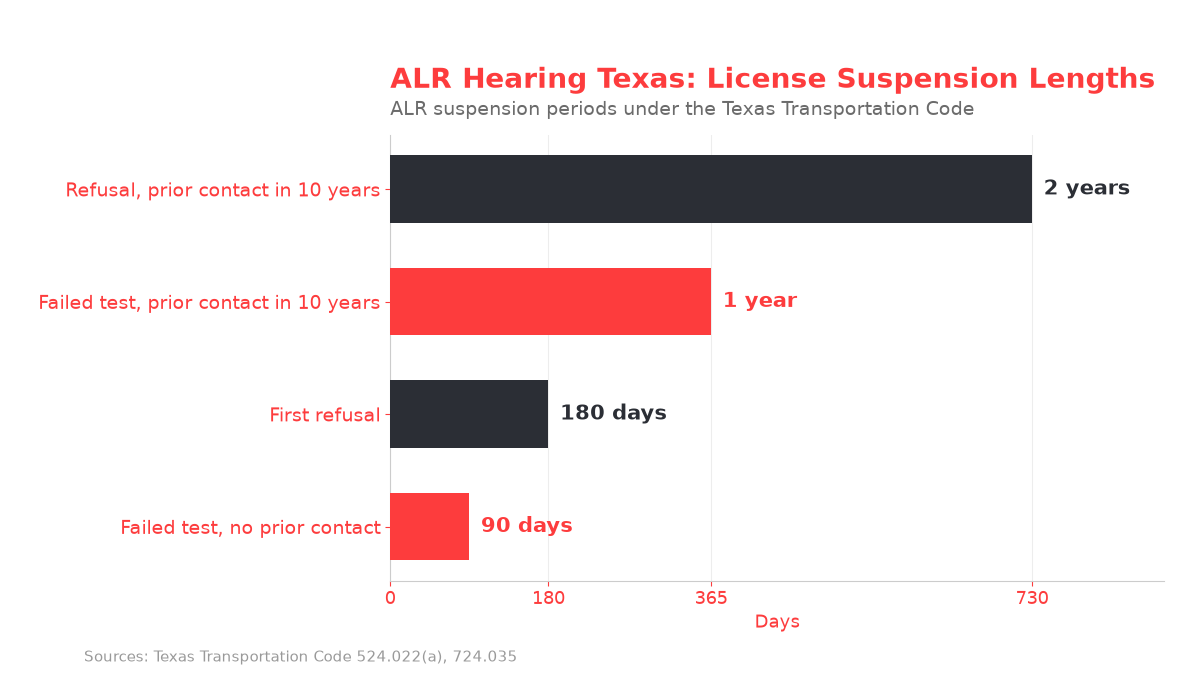
Suspension length under the ALR process depends on whether you failed or refused the test, and whether your driving record shows prior alcohol or drug-related enforcement contacts in the last 10 years.
Under the Texas Transportation Code, the suspension periods are:
- Failed breath or blood test (BAC at or above 0.08 percent, driver 21 or older): 90 days with no prior enforcement contact in the preceding 10 years; one year if a prior contact exists (Transportation Code 524.022(a)).
- Refusal to provide a specimen: 180 days for a first refusal; two years if the driving record shows a prior alcohol or drug-related enforcement contact in the preceding 10 years (Transportation Code 724.035).
Those are the ALR-specific suspension lengths. A criminal DWI conviction can add a separate court-ordered suspension on top of them. For a detailed look at what a first criminal charge carries, see our overview of first-time DWI in Texas.
If you are suspended, you may be eligible for an occupational driver’s license under Transportation Code Chapter 521 Subchapter L. That license permits restricted driving for work, school, and essential household needs during the suspension period. It does not restore full privileges, and a court order is required.
What Are Your Chances of Winning an ALR Hearing in Texas?
No attorney can promise or predict a specific outcome, and any claim of guaranteed results should raise a red flag. What can be said is that DPS carries the burden of proof, and that burden creates real opportunities to challenge the suspension.
Several factors influence how the hearing unfolds:
- Officer appearance: DPS must produce the arresting officer. If the officer fails to appear, the case against suspension often cannot proceed.
- Lawfulness of the stop: If the initial traffic stop lacked reasonable suspicion, the evidence that follows may be challengeable.
- Probable cause for arrest: Whether the officer had sufficient grounds to arrest you for DWI is a threshold question the judge must resolve.
- Test administration and equipment: Whether the breath or blood test followed required protocols, and whether the instrument was properly maintained and certified, are technical grounds that require a close reading of the DPS file.
Buck Johnson spent years as a prosecutor building the same DWI cases that trigger ALR suspensions. He knows which gaps in the DPS file are worth pressing and which are routine. That background, combined with the technical understanding of breath test and blood test challenges, shapes how he approaches each hearing.
Past results on specific cases are not a guarantee of what any future ALR hearing will produce. Every case turns on its own facts.
How Do You Request an ALR Hearing in Texas Before the 15-Day Deadline?
Speed matters above everything else here. The Texas DPS alcohol-related offenses page confirms the hearing request must be received at DPS headquarters in Austin within 15 days of the date you received the Notice of Suspension.
Follow these steps carefully:
- Submit in writing. A verbal request does not count. The request must be a written document.
- Send to the right place. The request must arrive at DPS headquarters in Austin, not a local DPS office. Sending it to the wrong office does not satisfy the requirement.
- Arrive by day 15, not postmarked. Faxing or mailing the request in time is not enough if it arrives after day 15. Plan for delivery time.
- Include required information. Your full name, date of birth, driver’s license number, and the date of the suspension notice must all appear in the request.
- Have an attorney submit it. An attorney can file on your behalf, which creates a documented record that the deadline was met.
If you were arrested in the Dallas area, the 15-day window runs from the date printed on your Notice of Suspension, regardless of weekends or holidays. There are no extensions for calendar timing.
Can You Still Drive After a DWI Arrest in Texas If You Lose the ALR Hearing?
Yes, in limited circumstances. Losing the ALR hearing, or missing the deadline to request one, does not necessarily mean you cannot drive at all during the suspension period. For a full breakdown of what happens to your driving privileges at every stage of this process, review the driver’s license questions and ALR hearings page.
An occupational driver’s license, also called an essential needs license, allows restricted driving for work, school, and essential household errands during an ALR suspension. A court order is required, and the judge may impose conditions such as an ignition interlock device. The occupational license does not restore full driving privileges; it defines specific approved hours and routes.
Reinstatement of a full license after the suspension period requires payment of a reinstatement fee to Texas DPS and completion of any court-ordered conditions. Starting that process promptly after the suspension ends prevents additional delays.
Contact Buck Johnson Law for DWI Defense in Dallas
The 15-day deadline does not wait, and neither should you. If you or a family member has been arrested for DWI in Dallas or anywhere in North Texas, Buck Johnson Law is ready to file the ALR hearing request, build the challenge to the suspension, and handle the criminal defense at the same time. Learn more about DWI defense in Dallas or call the firm today to speak directly with a former prosecutor who knows this process from both sides.