
Most people assume that a DWI charge requires alcohol or illegal drugs, but the reality is that prescription medications can lead to a DWI arrest in Texas. So if you are wondering if you can get a prescription drug DWI, the answer is yes. Under Texas law, driving while impaired by any substance, including legally prescribed drugs, is a criminal offense.
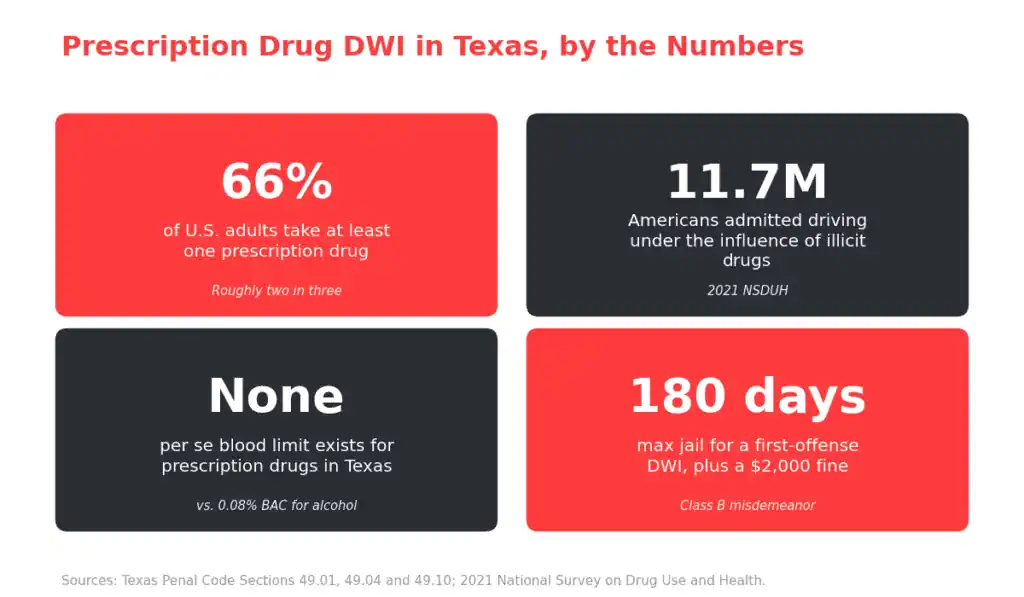
According to the 2021 National Survey on Drug Use and Health, approximately 11.7 million Americans admitted to driving under the influence of illicit drugs, a figure that does not even fully account for those impaired by prescription medications. With roughly 66 percent of American adults taking at least one prescription drug, this issue affects far more drivers than many people realize.
How Texas DWI Laws Apply to Prescription Drugs
Texas Penal Code Section 49.01 defines intoxication as not having the normal use of mental or physical faculties due to the introduction of alcohol, a controlled substance, a drug, a dangerous drug, a combination of two or more of those substances, or any other substance into the body. The key phrase here is “any other substance.” This broad definition means that virtually any medication that affects your ability to drive safely can serve as the basis for a DWI charge.
What surprises most drivers is that having a valid prescription does not provide a legal defense against a DWI charge in Texas. Section 49.10 of the Texas Penal Code explicitly states that being entitled to use a substance is not a defense to an intoxication offense. Texas courts have consistently upheld DWI convictions even when the defendant had a valid prescription for the medication in question. The law focuses on impairment, not legality of possession.
How Impairment from Prescription Drugs Is Measured
Unlike alcohol-related DWI cases, where a blood alcohol concentration of 0.08 percent or higher creates a “per se” presumption of intoxication, there is no equivalent threshold for prescription drugs in Texas. There is no specific blood level of a medication that automatically constitutes impairment under the law. Instead, the determination of impairment in a prescription drug DWI case rests almost entirely on the subjective observations of the arresting officer.
Officer Observations and Field Sobriety Tests
When an officer suspects drug impairment, they will typically note their observations of your driving behavior, your physical appearance, your speech patterns, and your ability to follow instructions. The officer will likely administer the standard field sobriety tests: the Horizontal Gaze Nystagmus test, the Walk-and-Turn test, and the One-Leg Stand test. Many prescription medications can cause symptoms such as drowsiness, dizziness, and impaired coordination that may lead to poor performance on these tests, even when the medication is taken exactly as prescribed.
Drug Recognition Expert (DRE) Evaluations
If the officer suspects drug impairment rather than alcohol impairment, they may call in a Drug Recognition Expert. DREs are officers who have received additional training to conduct a 12-step evaluation protocol designed to identify signs of drug impairment. However, these evaluations are largely subjective, and the DRE protocol has faced significant criticism from defense attorneys and scientists for its lack of rigorous scientific validation.
Blood Testing
Following a prescription drug DWI arrest, law enforcement will typically seek a blood sample to test for the presence of drugs in your system. If you refuse, the officer can obtain a warrant to draw your blood. It is important to understand that the mere presence of a medication in your blood does not prove impairment. Many prescription drugs can remain detectable in the bloodstream long after their impairing effects have worn off, which is a critical distinction your defense attorney can use in your favor.
Common Prescription Drugs That Lead to DWI Arrests
While any medication with side effects that affect driving ability can potentially lead to a DWI charge, certain categories of prescription drugs are more frequently involved in Texas DWI arrests than others.
Opioid pain medications such as oxycodone, hydrocodone, and codeine are among the most commonly flagged drugs because they can cause significant drowsiness, slowed reaction times, and impaired judgment. Anti-anxiety medications like alprazolam (Xanax) and diazepam (Valium) are also frequently cited, as benzodiazepines are known to cause sedation, confusion, and impaired motor function. Muscle relaxants such as carisoprodol (Soma) and cyclobenzaprine can produce drowsiness and dizziness that mimic the signs officers look for during DWI investigations.
Sleep medications, certain antidepressants, and even some antihistamines and over-the-counter cold medicines can also result in impairment-related stops and arrests. If the label on your medication warns against operating heavy machinery, that is a clear signal that the drug could affect your driving ability and put you at risk of a DWI arrest.
How to Defend Against a Prescription Drug DWI Charge
Prescription drug DWI cases present unique defense opportunities that an experienced attorney can leverage to challenge the charges against you.
Challenging the Evidence of Impairment
Because there is no “per se” drug level that proves impairment, the prosecution must rely heavily on the officer’s subjective observations to demonstrate that you lacked the normal use of your mental or physical faculties. Your defense attorney can challenge the reliability of field sobriety tests, question the officer’s training and qualifications, and introduce evidence that your behavior was consistent with normal medication use rather than impairment.
Questioning Blood Test Accuracy
Blood testing in drug DWI cases is far more complex than in alcohol cases. Laboratories must follow specific chain-of-custody protocols and use validated testing methods. Your attorney can challenge whether proper procedures were followed at every stage of the testing process. Additionally, the presence of a drug in your system does not equate to impairment at the time of driving, and an expert witness can explain the difference between detectable drug levels and levels that actually cause impairment.
Presenting Medical Evidence
Your attorney can work with medical professionals to demonstrate that your medication was being taken at a therapeutic dose, that you had developed a tolerance to its impairing side effects, or that your symptoms were caused by a medical condition rather than drug impairment. Medical records, pharmacy records, and expert testimony can all serve as powerful tools in building your defense.
Contact a Dallas–Fort Worth DWI Attorney Who Understands Prescription Drug Cases
A prescription drug DWI charge in Texas carries the same severe penalties as an alcohol-related DWI, including jail time, fines, and license suspension. But these cases also come with unique complexities that demand an attorney who understands the science of pharmacology, the limitations of drug testing, and the weaknesses of subjective impairment evaluations.
If you have been arrested for DWI in the Dallas–Fort Worth area after taking prescription medication, do not assume that a valid prescription will protect you. Instead, take action by contacting Buck Johnson Law for a consultation. Our team has the knowledge and experience to challenge the evidence against you and fight for the best possible outcome in your case.