
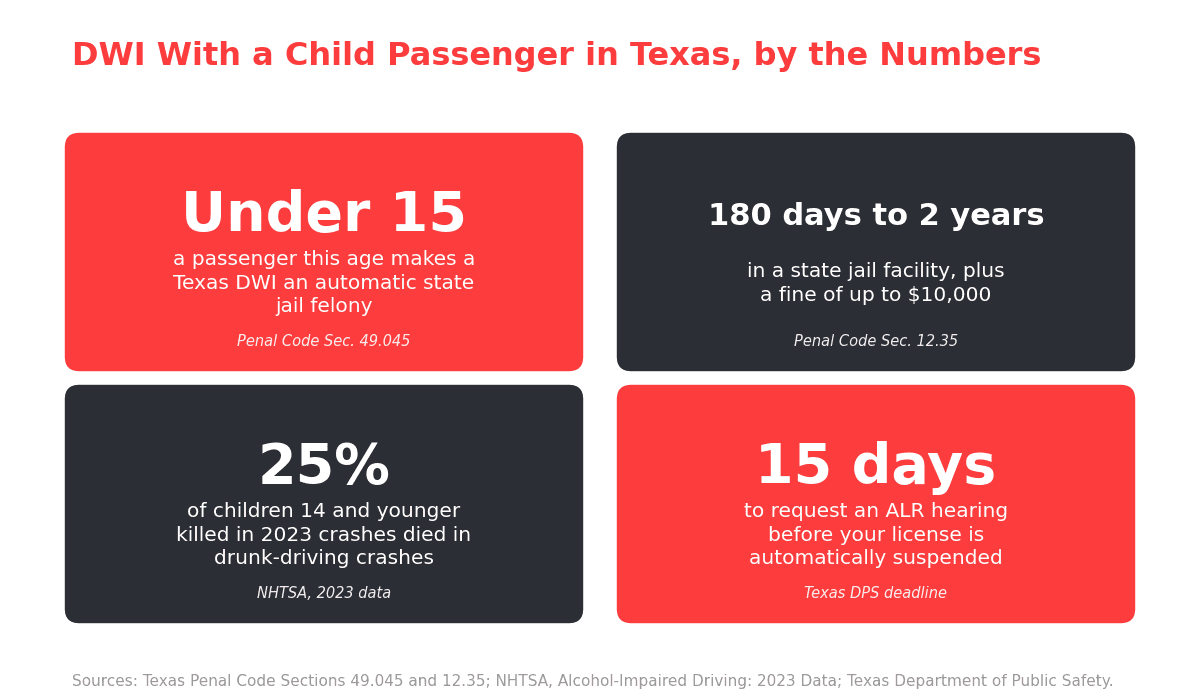
A DWI with a child passenger in Texas is one of the most heavily penalized impaired driving offenses in the state. While a standard first-time DWI is typically charged as a misdemeanor, the presence of a passenger younger than 15 years old automatically elevates the charge to a state jail felony, even if it is your first offense and even if no accident occurred. The stakes are enormous. According to the National Highway Traffic Safety Administration, 25 percent of children aged 14 and younger killed in motor vehicle crashes in 2023 died in drunk-driving incidents, and more than half of those children were passengers in the vehicle driven by the impaired driver. Texas takes these cases extremely seriously, and anyone facing this charge needs to understand exactly what is at stake and what steps to take immediately.
How a Child Passenger Elevates a DWI to a Felony
Under Texas Penal Code Section 49.045, a person commits the offense of DWI with a child passenger when they operate a motor vehicle in a public place while intoxicated and the vehicle is occupied by a passenger who is younger than 15 years of age. This is a standalone offense that is separate from a standard DWI charge, and the classification as a state jail felony is automatic.
What makes this law particularly consequential is that the prosecution does not need to prove that the child was actually harmed or endangered in any specific way. The child’s mere presence in the vehicle during the DWI offense is sufficient to trigger felony charges. It does not matter whether you were driving safely, whether the child was properly restrained in a car seat, or whether your blood alcohol concentration was barely above the legal limit. The law treats the combination of intoxicated driving and a minor’s presence as an inherently dangerous situation worthy of felony-level consequences.
This automatic elevation applies regardless of your criminal history. A person with no prior arrests, no prior traffic violations, and an otherwise clean record will face the same felony charge as someone with multiple prior offenses. This is a critical distinction from standard DWI cases, where the severity of the charge typically increases only with repeat offenses.
Penalties and CPS Involvement
Criminal Penalties
As a state jail felony under Texas Penal Code Section 12.35, a DWI with a child passenger conviction carries a jail sentence ranging from 180 days to two years in a state jail facility and a fine of up to $10,000. Your driver’s license will also be suspended for up to 180 days, and you may be required to install an ignition interlock device on your vehicle. Additionally, Texas law imposes annual surcharges of $1,000 to $2,000 for three years to retain your driving privileges after conviction.
It is also important to know that penalties can be enhanced beyond the standard state jail felony range if aggravating factors are present. A prior DWI conviction, a blood alcohol concentration above 0.15, or an accident involving injuries can all result in elevated charges and more severe sentencing. The state may also seek a repeat DWI enhancement that raises the offense to a third-degree felony.
Child Protective Services (CPS) Involvement
Beyond the criminal penalties, a DWI with a child passenger arrest triggers consequences that extend into your family life. Texas law requires prosecutors to report these cases to the Texas Department of Family and Protective Services, commonly known as CPS. Once a report is filed, CPS may initiate an investigation into whether the child is safe in your care.
A CPS investigation can result in temporary removal of the child from your custody, ongoing supervision of your household, mandatory participation in substance abuse programs, and in the most serious cases, permanent changes to your custody arrangement. It is critical to understand that CPS proceedings are separate from your criminal case and operate under a different legal standard. Even if you are ultimately acquitted of the DWI charge, the CPS investigation and its consequences may continue independently.
Collateral Consequences
A felony conviction on your record carries long-term repercussions that extend well beyond the courtroom. You may face difficulty finding employment, securing housing, obtaining professional licenses, and maintaining educational financial aid. A felony DWI conviction can also affect your right to own firearms and your ability to vote while incarcerated. Unlike standard DWI cases, Texas law prohibits deferred adjudication for DWI with a child passenger, which means there is no path to completing probation and avoiding a conviction on your record.
How to Build a Defense Against DWI with a Child Passenger Charges
Despite the severity of these charges, a DWI with a child passenger case can be challenged and potentially dismissed or reduced. An experienced defense attorney will examine every aspect of the arrest and the evidence to identify weaknesses in the prosecution’s case.
Challenging the legality of the initial traffic stop is often the first line of defense. If the officer did not have reasonable suspicion to pull you over, any evidence obtained during the stop, including field sobriety test results, breath or blood test results, and the officer’s observations, may be inadmissible in court. Your attorney can also challenge the accuracy of breath or blood tests by examining whether proper procedures were followed during testing, whether the testing equipment was properly calibrated, and whether the chain of custody for blood samples was maintained.
Video evidence from dashcams and body cameras can also play a crucial role. In many cases, the footage contradicts the officer’s written report or reveals that field sobriety tests were administered improperly. Expert witnesses may be called to testify about the limitations of the tests or the science behind blood alcohol testing.
Steps to Take Immediately After a DWI with Child Passenger Arrest
The actions you take in the hours and days following your arrest can have a significant impact on the outcome of your case. First and foremost, exercise your right to remain silent. Be polite and cooperative with officers, but do not volunteer information about where you were, what you consumed, or how much you drank. Anything you say can and will be used against you.
Time is especially critical in these cases because you have only 15 days from the date of your arrest to request an Administrative License Revocation (ALR) hearing with the Texas Department of Public Safety. If you fail to request this hearing within that window, your driver’s license will be automatically suspended. Contact a DWI defense attorney immediately so they can file this request on your behalf and begin building your defense while evidence is still fresh.
You should also begin preparing for the possibility of a CPS investigation by documenting your parenting responsibilities, gathering character references, and following any conditions of your release to the letter. An attorney experienced in DWI with child passenger cases can guide you through both the criminal defense process and the CPS investigation simultaneously.
Get Experienced Legal Help from a Dallas–Fort Worth DWI Defense Lawyer
A DWI with a child passenger charge threatens your freedom, your finances, your career, and your relationship with your children. The consequences of a conviction are severe and long-lasting, but these cases are not hopeless. With the right attorney fighting on your side, the evidence can be challenged, the charges can potentially be reduced or dismissed, and your rights can be protected throughout the process.
If you or someone you love is facing DWI with a child passenger charges in the Dallas–Fort Worth area, contact Buck Johnson Law today. Our team has the experience and determination to aggressively defend your case and work toward the best possible outcome. Do not wait. Every day counts when your future and your family are on the line.